NEMA 34 Stepper Motors: A Complete Guide for Industries
Modern industries rely heavily on precision motion control systems to improve productivity, accuracy, and automation. From CNC machinery and packaging equipment to robotics and industrial automation systems, motors play a crucial role in ensuring smooth and reliable operation. Among the various motion control solutions available today, stepper motors have become a preferred choice due to their exceptional positioning accuracy, repeatability, and cost-effectiveness.
Stepper motors are widely used in applications where precise control of rotational movement is required. Unlike conventional motors that rotate continuously when powered, stepper motors move in fixed increments, making them ideal for applications demanding accurate positioning. Their ability to operate without complex feedback systems further enhances their popularity across multiple industries.
As manufacturing facilities continue adopting automation technologies, the demand for powerful and reliable stepper motors has increased significantly. Industrial applications often require motors capable of handling heavy loads, maintaining high torque levels, and delivering consistent performance under demanding operating conditions.
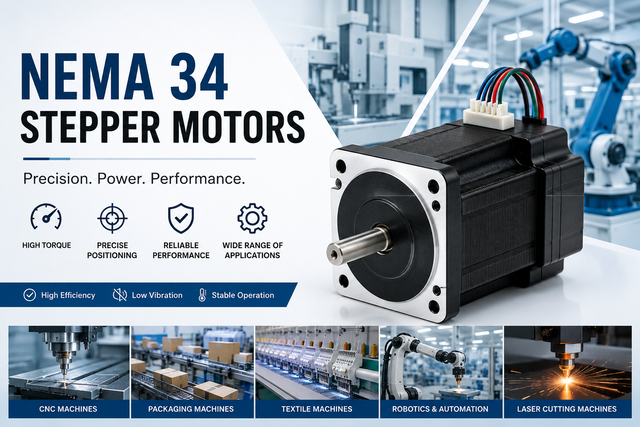
Among the various frame sizes available, NEMA 34 Stepper Motors have emerged as one of the most widely used solutions for industrial motion control applications. These motors provide an excellent balance of torque, precision, reliability, and affordability, making them suitable for a broad range of industrial equipment and machinery.
This comprehensive guide explores everything industries need to know about NEMA 34 stepper motors, including their construction, working principles, advantages, applications, selection criteria, maintenance requirements, and future trends.
What Are NEMA 34 Stepper Motors?
NEMA 34 stepper motors belong to a standardized frame size classification established by the National Electrical Manufacturers Association (NEMA). The designation “34” refers to the motor’s faceplate dimensions, which are approximately 3.4 inches by 3.4 inches (86 mm x 86 mm).
It is important to understand that the NEMA designation only specifies mounting dimensions and does not indicate the motor’s torque, power, current rating, or performance characteristics.
NEMA 34 stepper motors are generally larger and more powerful than NEMA 17 and NEMA 23 motors. They are designed to handle heavier loads and deliver higher torque outputs, making them ideal for industrial automation systems requiring robust motion control.
How NEMA 34 Stepper Motors Work
A stepper motor converts electrical pulses into precise mechanical movement. Each pulse sent to the motor driver causes the rotor to move by a specific angle, known as a step.
Most NEMA 34 motors are hybrid stepper motors, combining the features of permanent magnet and variable reluctance technologies. This hybrid design provides excellent torque, accuracy, and efficiency.
The motor consists of:
- Rotor
- Stator
- Windings
- Bearings
- Shaft
When electrical current flows through the stator windings in a controlled sequence, magnetic fields are generated. These magnetic fields attract the rotor teeth, causing the rotor to move incrementally.
Each pulse corresponds to a fixed rotational movement, typically:
- 1.8° per step
- 200 steps per revolution
With microstepping technology, even smaller increments can be achieved for enhanced precision.
Key Features of NEMA 34 Stepper Motors
High Torque Output
One of the primary reasons industries choose NEMA 34 stepper motors is their impressive torque capability.
Depending on the model, these motors can generate holding torque ranging from:
- 4 Nm
- 6 Nm
- 8 Nm
- 12 Nm
- 15 Nm
- More than 20 Nm
This makes them suitable for heavy-duty industrial applications.
Excellent Positioning Accuracy
Stepper motors move in discrete steps, enabling highly accurate positioning without requiring expensive feedback systems.
Typical accuracy levels include:
- ±5% of a step angle
- Repeatable positioning
- Consistent motion control
Reliable Operation
NEMA 34 motors are designed for continuous industrial operation and can withstand demanding working conditions.
Easy Integration
Their standardized mounting dimensions simplify installation and replacement in existing machinery.
Cost-Effective Automation
Compared to servo systems, stepper motors often provide a lower-cost solution while maintaining excellent performance for many applications.
Advantages of NEMA 34 Stepper Motors
Precise Motion Control
Industrial processes often require exact positioning. NEMA 34 stepper motors provide highly accurate motion control, ensuring repeatable performance.
High Holding Torque
Even when stationary, the motor can maintain its position under load, making it ideal for vertical and indexing applications.
Simplified Control Systems
Unlike servo motors, many stepper motor systems can operate without feedback devices, reducing complexity and installation costs.
Low Maintenance
Their rugged construction and absence of brushes result in minimal maintenance requirements.
Long Service Life
When properly sized and maintained, NEMA 34 stepper motors can provide years of reliable operation.
Strong Low-Speed Performance
These motors generate significant torque at low speeds, making them ideal for precision positioning applications.
Common Industrial Applications
CNC Machines
NEMA 34 stepper motors are extensively used in:
- CNC routers
- Milling machines
- Plasma cutters
- Engraving systems
- Laser cutting equipment
Their high torque and precise positioning capabilities make them perfect for these applications.
Industrial Robotics
Robotic systems frequently require accurate and repeatable motion control.
Applications include:
- Robotic arms
- Pick-and-place systems
- Automated assembly lines
- Inspection systems
Packaging Machinery
Packaging equipment relies heavily on motion control systems.
Common uses include:
- Conveyor control
- Labeling machines
- Filling systems
- Carton handling equipment
Printing Equipment
Modern printing systems utilize stepper motors for:
- Print head positioning
- Material feeding
- Registration control
- Roll handling
Textile Industry
Textile machinery often incorporates NEMA 34 stepper motors for:
- Fabric handling
- Cutting systems
- Sewing automation
- Embroidery machines
Semiconductor Manufacturing
Precision is critical in semiconductor production.
Stepper motors help control:
- Wafer positioning
- Inspection equipment
- Automated handling systems
Understanding Torque Ratings
When selecting a NEMA 34 stepper motor, torque is one of the most important considerations.
Holding Torque
Holding torque refers to the maximum torque the motor can resist while maintaining position when energized.
Running Torque
Running torque represents the available torque while the motor is rotating.
Pull-In Torque
This indicates the maximum load torque that allows the motor to start and stop without losing synchronization.
Pull-Out Torque
Pull-out torque represents the maximum torque the motor can deliver while operating at a specific speed.
Industries should always review the torque-speed curve before selecting a motor.
NEMA 34 vs NEMA 23 Stepper Motors
| Feature | NEMA 23 | NEMA 34 |
| Frame Size | 57 mm | 86 mm |
| Torque Output | Moderate | High |
| Load Capacity | Medium | Heavy |
| Current Rating | Lower | Higher |
| Industrial Use | Light-Medium Duty | Heavy Duty |
| Cost | Lower | Higher |
For demanding industrial applications, NEMA 34 motors often provide the necessary performance and reliability.
Open-Loop vs Closed-Loop Systems
Open-Loop Systems
In traditional stepper motor systems:
- No position feedback is used.
- Controller assumes all commanded steps are executed.
- Lower cost.
- Simpler design.
Closed-Loop Systems
Closed-loop systems include encoders that monitor actual motor position.
Benefits include:
- Improved accuracy
- Reduced missed steps
- Better efficiency
- Higher operating speeds
Many modern industrial applications are transitioning toward closed-loop NEMA 34 stepper motor systems.
Factors to Consider When Choosing NEMA 34 Stepper Motors
Required Torque
Calculate the torque required to move the load under worst-case conditions.
Operating Speed
Determine the maximum speed needed for the application.
Power Supply Voltage
Higher voltages generally improve high-speed performance.
Driver Compatibility
Ensure the motor is compatible with the selected motor driver.
Environmental Conditions
Consider:
- Temperature
- Dust
- Moisture
- Vibration
Duty Cycle
Continuous-duty applications may require enhanced cooling and higher-quality motors.
Importance of Motor Drivers
A stepper motor driver controls current flow to the motor windings.
Functions include:
- Pulse interpretation
- Current regulation
- Microstepping control
- Motor protection
Advanced drivers provide:
- Anti-resonance technology
- Automatic tuning
- Over-current protection
- Over-temperature protection
Selecting the right driver significantly impacts overall system performance.
Microstepping Technology
Microstepping divides a full motor step into smaller increments.
Benefits include:
- Smoother motion
- Reduced vibration
- Lower noise levels
- Improved positioning resolution
Common microstepping settings include:
- 2 microsteps
- 4 microsteps
- 8 microsteps
- 16 microsteps
- 32 microsteps
- 64 microsteps
Industrial automation systems often use microstepping to achieve enhanced motion quality.
Common Challenges and Solutions
Motor Overheating
Causes:
- Excessive current
- Poor ventilation
- Continuous high-load operation
Solutions:
- Proper current settings
- Cooling systems
- Heat sinks
Missed Steps
Causes:
- Overloading
- Excessive acceleration
- Incorrect driver settings
Solutions:
- Increase torque margin
- Reduce acceleration rates
- Optimize motion profiles
Resonance Issues
Causes:
- Natural vibration frequencies
Solutions:
- Microstepping
- Dampers
- Closed-loop control
Maintenance Best Practices
Although stepper motors require relatively little maintenance, routine inspection improves reliability.
Regular Cleaning
Remove:
- Dust
- Debris
- Oil contamination
Check Mounting Hardware
Inspect:
- Bolts
- Couplings
- Motor mounts
Monitor Temperature
Unusual temperature increases may indicate problems.
Inspect Bearings
Listen for:
- Noise
- Vibration
- Rough operation
Verify Electrical Connections
Loose wiring can lead to performance issues and unexpected downtime.
Energy Efficiency Considerations
Industrial facilities increasingly focus on energy efficiency.
Modern NEMA 34 stepper motor systems improve efficiency through:
- Advanced drivers
- Current reduction technology
- Closed-loop operation
- Optimized motion profiles
Reducing energy consumption lowers operating costs and supports sustainability initiatives.
Future Trends in Industrial Motion Control
The motion control industry continues evolving rapidly.
Key trends include:
Smart Motors
Integrated electronics simplify installation and diagnostics.
IoT Connectivity
Industrial motors increasingly connect to factory networks for monitoring and predictive maintenance.
Closed-Loop Adoption
More manufacturers are adopting encoder-equipped stepper systems.
Improved Driver Technology
Modern drivers provide:
- Better efficiency
- Lower noise
- Enhanced reliability
Industry 4.0 Integration
NEMA 34 stepper motors are becoming part of intelligent manufacturing ecosystems that support real-time monitoring and automation.
Conclusion
NEMA 34 stepper motors have become a cornerstone of industrial automation due to their exceptional combination of torque, precision, reliability, and affordability. Their ability to provide accurate positioning without requiring complex feedback systems makes them an attractive solution for a wide variety of industrial applications, including CNC machinery, robotics, packaging systems, printing equipment, textile machinery, and automated manufacturing processes.
By understanding key factors such as torque requirements, operating speed, driver selection, environmental conditions, and maintenance practices, industries can maximize the performance and lifespan of these powerful motors. As automation technologies continue advancing, NEMA 34 stepper motors will remain a critical component in modern motion control systems, helping manufacturers achieve greater productivity, efficiency, and operational excellence.