Label Gap Sensor for Automation: Types, Applications & Benefits
Automation has transformed the way manufacturers package, identify, and track products. Modern production lines can process hundreds or thousands of items every hour, making precision essential at every stage. A Label Gap Sensor plays an important role in automated labeling systems by detecting the spaces between labels and helping machines apply each label accurately. From food and beverage packaging to pharmaceuticals, logistics, electronics, and consumer goods, these sensors support faster, more reliable, and more consistent labeling operations.
Although labeling may seem like a straightforward process, automated systems must perform several actions within fractions of a second. A machine needs to identify the position of the label, control the movement of the label web, dispense the label at the correct moment, and coordinate the application process with the movement of the product. If the sensor fails to detect the gap accurately, the entire sequence can be disrupted.
This is why sensor technology has become an essential part of industrial automation. The right sensing solution can reduce waste, improve product quality, minimize downtime, and help manufacturers maintain stable production speeds.
What Is a Label Gap Sensor?
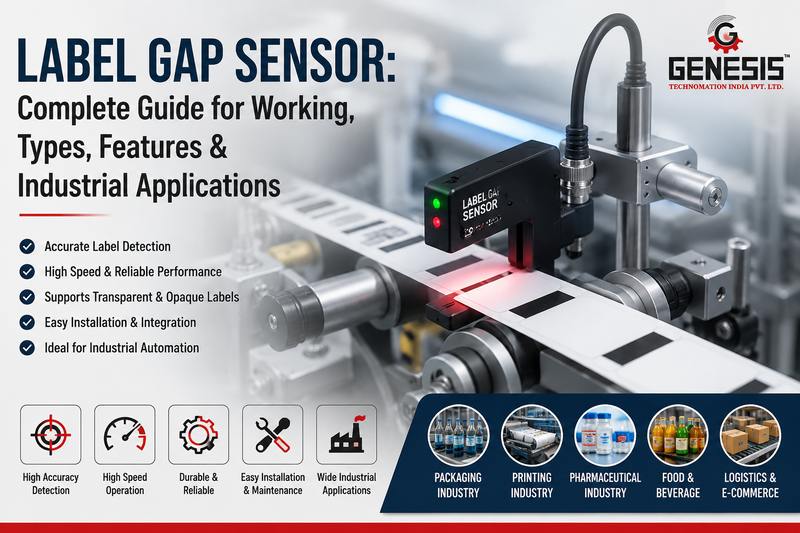
A Label Gap Sensor is an industrial sensor designed to detect the difference between a label and the gap or backing material on a continuous label web. Labels are typically supplied on rolls, with each individual label separated by a small space. The sensor detects this difference and sends a signal to the labeling machine or control system.
The machine uses this signal to determine where a label begins and ends.
For example, when a labeling machine feeds a roll of labels toward an applicator, the sensor monitors the moving material. Once it detects the gap between two labels, the control system can trigger the next step in the labeling process. This may involve stopping the label feed, adjusting its position, or releasing the next label for application.
Without accurate gap detection, labels may be applied too early, too late, or in the wrong position.
Why Are Label Gap Sensors Important in Automation?
Industrial automation depends on repeatability. Every product passing through a production line should receive the same treatment, even when the system operates at high speed for extended periods.
Label detection supports this consistency.
A reliable sensor helps automate several important functions, including:
- Label dispensing
- Product identification
- Packaging synchronization
- Printing and application
- Position control
- High-speed material handling
- Quality assurance
The sensor acts as a source of real-time information. It tells the machine what is happening to the label web at a specific moment.
This information may appear simple, but timing is everything. A delay of even a few milliseconds can affect label placement on a fast-moving production line.
How Does a Label Gap Sensor Work?
The exact operating principle depends on the sensor technology. However, the basic process is similar across most applications.
The label web passes through or in front of the sensor. The sensor continuously evaluates the material and identifies a measurable difference between the label and the gap.
That difference may involve:
- Light transmission
- Light reflection
- Material thickness
- Ultrasonic response
- Electrical capacitance
When the sensor detects the transition from the label to the gap, it changes its output signal. The machine controller receives this information and uses it to control the next operation.
A typical automated sequence works as follows:
- A label roll is fed into the machine.
- The label web moves through the sensor’s detection area.
- The sensor identifies the presence of a label.
- The label continues moving toward the dispensing point.
- The sensor detects the gap.
- A switching signal is sent to the controller.
- The machine adjusts the label feed or triggers the dispensing process.
- The label is applied to the product.
This entire sequence can occur repeatedly at very high speed.
Main Types of Label Gap Sensors
There is no single sensor technology that works perfectly for every label material. Different applications require different detection methods.
Understanding the available types makes the selection process much easier.
Through-Beam Sensors
Through-beam sensors use a light emitter and receiver positioned on opposite sides of the label material.
As the label web passes through the sensing area, the amount of light reaching the receiver changes depending on whether a label or a gap is present. The sensor recognizes this difference and generates an output.
Through-beam technology is commonly used because it offers:
- Fast response times
- Reliable detection
- Good performance in high-speed applications
- Stable operation with suitable materials
These sensors are particularly useful when the label and backing material have enough difference in optical transmission.
However, highly transparent materials may require more advanced sensing technology.
Ultrasonic Label Sensors
Ultrasonic sensors use sound waves rather than visible light.
This makes them especially useful for detecting difficult materials, including transparent labels and clear films. Instead of depending mainly on color or optical contrast, ultrasonic technology detects differences in the physical structure of the material.
When the ultrasonic signal passes through the backing material, it behaves differently than when it passes through a section containing both the label and backing.
The sensor detects this change.
Ultrasonic technology is often chosen for:
- Transparent labels
- Clear plastic labels
- Highly reflective materials
- Film-based labels
- Applications with low optical contrast
One of the biggest benefits is that printed colors or graphics generally have less influence on detection than they do with some optical sensing methods.
Optical Contrast Sensors
Optical contrast sensors identify differences in reflected light.
They are often used when the label, backing material, or registration mark provides sufficient contrast. Depending on the sensor design, it may use visible, red, green, blue, or other light wavelengths to improve material recognition.
These sensors can be effective in applications where the visual properties of the material are consistent.
However, glossy surfaces, changing print patterns, reflective materials, and transparent labels can sometimes make reliable detection more challenging.
Capacitive Sensors
Capacitive sensors detect changes in the electrical properties of nearby materials.
In certain label handling applications, they can distinguish between the label and the backing material based on differences in thickness or dielectric properties.
Capacitive sensing can be useful in specialized situations, but its performance may be influenced by environmental factors and the characteristics of the materials being detected.
Specialized Label Sensors
Some manufacturers offer sensors specifically engineered for labeling machines.
These may combine multiple sensing technologies, advanced signal processing, automatic calibration, and digital adjustment features.
Specialized sensors can provide better performance when applications involve:
- Very small label gaps
- High web speeds
- Multiple label materials
- Frequent product changeovers
- Transparent or metallic labels
- Complex machine integration
Fork Sensors in Automated Labeling Systems
Fork sensors are commonly used in automation because of their compact design and simple installation. They feature a U-shaped housing with a sensing gap between the two arms. The transmitter and receiver are positioned inside the same unit, while the material passes through the open space.
This design provides several advantages.
First, alignment is easier. Since the sensing components are built into a single housing, the installer does not need to separately align an emitter and receiver.
Second, the compact structure is useful in machines where installation space is limited.
Third, fork sensors can provide fast and stable detection for a variety of materials.
In automated labeling systems, they may be used to detect:
- Label edges
- Label gaps
- Tags
- Paper materials
- Registration marks
- Small packaging components
Fork-style sensor designs are particularly attractive for machine builders who want a compact and repeatable sensing arrangement. The fixed sensing geometry can simplify installation and reduce setup time.
However, the sensor opening must be compatible with the width and movement of the label material. The response speed, sensing principle, and environmental requirements should also be reviewed carefully.
Key Applications of Label Gap Sensors
Label Gap Sensors are used in many industries because labels are essential for identification, branding, compliance, and product tracking.
Food and Beverage Packaging
Food and beverage manufacturers depend heavily on automated labeling systems.
Labels may be applied to:
- Water bottles
- Soft drink containers
- Jars
- Cans
- Pouches
- Food trays
- Boxes
Production lines in this sector often operate at high speed, so the sensor must respond quickly and consistently.
Accurate detection helps ensure that every product receives a correctly positioned label before moving to the next stage of packaging.
Pharmaceutical and Healthcare Manufacturing
In pharmaceutical applications, labeling accuracy can be especially important.
Labels may contain:
- Product names
- Dosage information
- Batch numbers
- Expiration dates
- Barcodes
- Regulatory details
- Serialization information
A missing or incorrectly positioned label can lead to quality issues and potentially serious consequences.
Sensors are used for labeling bottles, vials, syringes, cartons, medical devices, and other healthcare products.
Cosmetics and Personal Care Products
Cosmetic packaging often requires precise label placement for visual reasons.
A slightly misaligned label can affect the overall appearance of a premium product.
Automated systems use label detection sensors to support consistent application on:
- Shampoo bottles
- Lotion containers
- Cosmetic jars
- Perfume packaging
- Personal care products
Because packaging materials may be glossy or reflective, sensor selection can be particularly important.
Logistics and Warehousing
Shipping and inventory labels are essential for tracking goods.
Automated print-and-apply systems use sensors to control the movement and dispensing of labels. These labels may contain barcodes, addresses, routing information, product identifiers, and tracking details.
Reliable detection helps maintain speed in busy distribution environments.
Electronics Manufacturing
Electronic products and components often require small identification labels.
These may be applied to:
- Circuit boards
- Cables
- Connectors
- Industrial devices
- Consumer electronics
Small label sizes and narrow gaps can require highly accurate sensing.
Automotive Manufacturing
The automotive industry uses labels for component identification, traceability, safety information, and production tracking.
Automated label systems may operate in demanding environments where vibration, temperature changes, and continuous operation are common.
A robust sensor can help maintain stable performance under these conditions.
Benefits of Using Label Gap Sensors in Automation
The advantages extend beyond simply detecting a label.
Improved Accuracy
The most obvious benefit is better label positioning.
The sensor provides a reference point that allows the machine to synchronize label movement with the application process.
This improves consistency across thousands of products.
Higher Production Speeds
Automated production lines need sensors that can respond quickly.
A high-performance Label Gap Sensor can support faster web movement and more frequent labeling cycles without sacrificing accuracy.
Reduced Material Waste
Incorrect detection can result in wasted labels and damaged products.
Reliable sensing helps reduce:
- Misapplied labels
- Missing labels
- Double labels
- Machine stoppages
- Rejected products
Over time, even a small reduction in waste can create meaningful cost savings.
Less Machine Downtime
Sensor-related problems can stop an entire production line.
Selecting the correct sensor and maintaining it properly can reduce interruptions caused by detection failures.
Better Product Quality
Consistent label placement improves product appearance and supports quality standards.
This is especially important for consumer-facing products where packaging affects brand perception.
Greater Automation Reliability
Sensors provide the information required for automated decision-making.
When detection is reliable, the entire labeling system can operate with greater confidence and less operator intervention.
Factors to Consider When Selecting a Label Gap Sensor
Selecting the right sensor requires more than choosing a product with the fastest response time.
The complete application should be evaluated.
Label Material
Determine whether the labels are made from:
- Paper
- Plastic
- Polypropylene
- Polyester
- Transparent film
- Metallic material
Material properties strongly influence which sensing technology will work best.
Backing Material
The liner or backing material is equally important.
A transparent label on transparent backing can be difficult for conventional optical sensors because the difference between the label and the gap may be very small.
In such cases, ultrasonic technology may offer better results.
Minimum Gap Size
The sensor must be capable of reliably detecting the smallest gap on the label roll.
Very small gaps require precise sensing and fast signal processing.
Web Speed
Calculate the maximum speed of the label material.
The sensor’s response time must be fast enough to detect the transition between labels without missing the required signal.
Label Width and Machine Space
Consider how much installation space is available.
Compact sensors and fork-style configurations can be beneficial in tight machine layouts.
Environmental Conditions
The sensor should be suitable for the operating environment.
Consider:
- Dust
- Moisture
- Vibration
- Temperature
- Cleaning chemicals
- Production contaminants
Industrial protection ratings may be important for demanding environments.
Output and Control Compatibility
The sensor must work with the machine’s electrical and control system.
Check:
- Supply voltage
- Output type
- Switching logic
- PLC compatibility
- Connector type
A technically suitable sensor can still create integration problems if its electrical interface does not match the existing system.
Installation Best Practices
Proper installation is essential for reliable performance.
Start by mounting the sensor securely. Excessive vibration can create inconsistent signals or mechanical misalignment.
The label web should pass through the sensing area smoothly. Excessive movement, twisting, or tension changes can affect detection.
Calibration should always be performed using the actual label material used in production.
Testing should also be conducted at realistic operating speeds.
A sensor that performs well during a slow manual test may behave differently when the label web moves at full production speed.
Regular cleaning is another important maintenance practice. Dust, adhesive residue, or other contamination can interfere with some sensing technologies.
Common Challenges in Label Detection
Transparent Labels
Clear labels are among the most common challenges.
Because they may allow a large amount of light to pass through, the difference between the label and the backing material can be difficult for conventional optical sensors to detect.
Ultrasonic sensors are often considered for these applications.
Highly Reflective Materials
Metallic or glossy surfaces can produce inconsistent reflections.
Sensor positioning and technology selection are important when dealing with reflective labels.
Small Gaps
As the distance between labels becomes smaller, the available detection time also decreases.
High-resolution sensing and fast response times become more important.
High-Speed Production
High-speed lines demand stable performance.
The sensor must detect each label transition consistently without being affected by vibration, web movement, or electrical noise.
Frequent Material Changes
Production facilities that handle many different label types may need sensors with quick setup or automatic teach-in features.
This can reduce changeover time and operator error.
The Future of Label Detection in Automation
As manufacturing becomes more connected and intelligent, sensors are expected to provide more than simple switching signals.
Modern systems increasingly include:
- Automatic calibration
- Digital configuration
- Remote diagnostics
- Condition monitoring
- Improved material recognition
- Faster response speeds
- Compact designs
Smart sensors may also provide diagnostic information that helps maintenance teams identify problems before they cause production failures.
For example, a sensor may indicate that contamination is increasing or that the detection signal is becoming unstable.
This supports predictive maintenance and helps manufacturers avoid unexpected downtime.
Final Thoughts
A Label Gap Sensor is a critical component in modern automation systems. It helps machines identify the exact position of labels, synchronize dispensing, and maintain accurate application across a wide range of industrial processes.
The right sensor can improve speed, reduce waste, minimize downtime, and support consistent product quality. However, there is no universal solution for every labeling application.
The best choice depends on several factors, including label material, backing type, transparency, gap size, web speed, installation space, and environmental conditions.
Through-beam sensors can provide reliable performance for many standard applications. Ultrasonic technology is often valuable for transparent and difficult materials. Optical contrast sensors may work well where clear visual differences are available, while capacitive and specialized sensor technologies can address specific application requirements.
Before making a final selection, test the sensor with the actual labels, backing material, machine speed, and operating conditions used in production. Real-world testing is one of the best ways to confirm performance.
When properly selected and installed, a Label Gap Sensor becomes an important foundation for efficient, high-speed, and reliable labeling automation.