Industrial Laser Sensors Explained: Features, Uses and Benefits
Industrial automation has transformed the way modern factories operate, enabling businesses to achieve higher productivity, improved accuracy, and consistent product quality. As industries strive to meet increasing customer demands while reducing operational costs, the need for advanced sensing technologies has grown significantly. Among these innovations, laser sensors have become indispensable tools for precise measurement, object detection, and quality inspection. Their ability to deliver reliable, non-contact measurements makes them ideal for a wide range of industrial environments.
Unlike traditional contact-based measuring devices, laser sensors use focused beams of light to determine the position, distance, size, or presence of an object. This non-contact approach eliminates mechanical wear, minimizes maintenance, and allows measurements to be taken without interfering with the production process. Whether inspecting delicate electronic components or monitoring heavy machinery, laser sensors provide unmatched precision and repeatability.
Today, industries such as automotive, electronics, logistics, food processing, pharmaceuticals, and metal fabrication depend on laser sensing technology to maintain high manufacturing standards. These sensors not only improve operational efficiency but also reduce product defects, material waste, and production downtime.
As smart manufacturing and Industry 4.0 continue to reshape industrial operations, laser sensors are becoming even more intelligent. Many modern systems integrate with programmable logic controllers (PLCs), industrial networks, cloud platforms, and artificial intelligence-based inspection systems to support real-time decision-making and predictive maintenance.
Industrial Laser Sensors have become one of the most reliable sensing solutions for manufacturers seeking precision, speed, and automation. Their ability to accurately detect objects, measure distances, inspect surfaces, and monitor production lines makes them an essential component of modern industrial systems. From robotic assembly cells to automated warehouses, these sensors help businesses improve efficiency while ensuring consistent product quality.
What Are Industrial Laser Sensors?
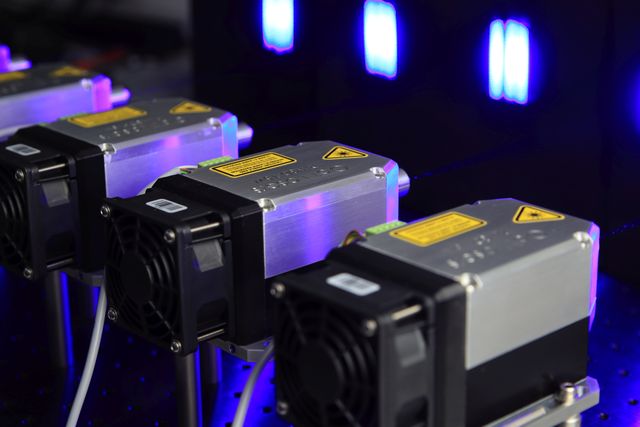
Industrial laser sensors are non-contact electronic devices that use laser light to measure distance, detect objects, inspect surfaces, and monitor position with exceptional accuracy. They emit a focused laser beam toward a target and analyze the reflected light to determine precise measurements.
Unlike conventional sensors that rely on physical contact or electromagnetic fields, laser sensors can operate without touching the object being measured. This makes them ideal for fragile materials, high-speed production lines, hot surfaces, and applications where physical contact could cause damage or affect measurement accuracy.
Industrial laser sensors are widely used in manufacturing environments because they provide reliable results even when dealing with small components, complex shapes, or rapidly moving objects.
How Industrial Laser Sensors Work
Although different models use various measurement principles, their operation generally follows a simple process.
Laser Emission
A semiconductor laser diode generates a narrow beam of light directed toward the target object.
Reflection
The laser beam strikes the object and reflects back to the sensor.
Signal Reception
The sensor’s optical receiver captures the reflected light.
Data Analysis
Advanced electronic circuits calculate the object’s distance, position, height, or size based on the reflected signal.
Output Communication
The measurement data is transmitted to industrial controllers, robotic systems, PLCs, or monitoring software for real-time process control.
Modern sensors perform this sequence thousands of times per second, making them suitable for high-speed automation.
Key Features of Industrial Laser Sensors
Industrial laser sensors offer numerous advanced features that distinguish them from traditional sensing technologies.
High Accuracy
One of the most significant advantages is their ability to provide highly accurate measurements. Many industrial laser sensors offer micron-level precision, making them suitable for applications requiring tight tolerances.
Non-Contact Measurement
Because there is no physical contact between the sensor and the object, laser sensors eliminate mechanical wear while protecting delicate materials from damage.
Fast Response Time
Industrial production lines operate at high speeds. Laser sensors provide rapid measurements that allow real-time monitoring without slowing production.
Long Measuring Range
Depending on the sensor type, measurement ranges may vary from a few millimeters to several hundred meters.
Excellent Repeatability
Laser sensors consistently produce nearly identical measurement results under the same operating conditions.
Compact Size
Many industrial models feature compact housings that simplify installation in robotic cells, conveyor systems, and automated machinery.
Digital Communication
Modern laser sensors support communication protocols such as:
- IO-Link
- Ethernet/IP
- PROFINET
- EtherCAT
- Modbus
- RS-485
These interfaces simplify integration with industrial automation systems.
Intelligent Diagnostics
Many advanced sensors include self-monitoring capabilities that report contamination, alignment problems, and performance issues before failures occur.
Common Types of Industrial Laser Sensors
Different industrial applications require different laser sensing technologies.
Laser Distance Sensors
These sensors accurately measure the distance between the sensor and an object.
Common applications include:
- Conveyor monitoring
- Height measurement
- Robotic positioning
- Warehouse automation
Laser Displacement Sensors
Designed for ultra-precise measurements, displacement sensors detect even microscopic movement.
Typical uses include:
- Thickness measurement
- Surface inspection
- Precision machining
- Semiconductor production
Laser Triangulation Sensors
These sensors determine object position by measuring the angle of reflected laser light.
Advantages include:
- High precision
- Fast measurement
- Excellent repeatability
- Compact design
Time-of-Flight (ToF) Sensors
Time-of-flight sensors calculate distance by measuring how long laser pulses take to return.
They are ideal for:
- Long-distance measurement
- Automated vehicles
- Logistics systems
- Construction equipment
Laser Profile Sensors
These sensors generate two-dimensional or three-dimensional profiles for inspection.
Applications include:
- Weld inspection
- Surface scanning
- Shape analysis
- Volume calculation
Industrial Applications
Industrial laser sensors support a wide variety of manufacturing and automation processes.
Automotive Manufacturing
Automotive companies use laser sensors for:
- Robot guidance
- Body alignment
- Weld inspection
- Paint thickness measurement
- Assembly verification
These applications improve vehicle quality while increasing production speed.
Electronics Manufacturing
Tiny electronic components require extremely accurate positioning.
Laser sensors assist with:
- PCB inspection
- Chip placement
- Connector alignment
- Surface inspection
Their precision reduces manufacturing defects.
Packaging Industry
Packaging facilities rely on laser sensors for:
- Box positioning
- Label verification
- Bottle inspection
- Fill level detection
- Carton counting
These sensors improve packaging accuracy while reducing waste.
Food and Beverage
Food manufacturers use laser sensors because they provide hygienic, non-contact inspection.
Applications include:
- Product counting
- Bottle detection
- Package positioning
- Conveyor monitoring
Pharmaceutical Industry
Laser sensors support:
- Tablet inspection
- Package verification
- Label positioning
- Bottle counting
Their high accuracy helps maintain strict regulatory standards.
Metal Processing
Laser sensors inspect:
- Steel thickness
- Surface defects
- Plate alignment
- Tube diameter
- Sheet positioning
Since no physical contact occurs, measurements remain accurate even on hot metal surfaces.
Wood Processing
Woodworking facilities use laser sensors for:
- Board thickness measurement
- Cutting alignment
- Surface flatness inspection
- Dimension verification
This minimizes material waste while improving product quality.
Warehouse Automation
Modern warehouses employ laser sensors for:
- Automated guided vehicles (AGVs)
- Pallet positioning
- Rack detection
- Parcel dimensioning
- Collision avoidance
These systems significantly improve logistics efficiency.
Benefits of Industrial Laser Sensors
Improved Accuracy
Laser sensors deliver highly precise measurements that improve manufacturing quality.
Increased Productivity
Fast measurement speeds reduce production bottlenecks and support continuous manufacturing.
Reduced Product Defects
Accurate inspection helps identify problems before defective products reach customers.
Lower Maintenance Costs
Non-contact operation reduces mechanical wear and minimizes maintenance requirements.
Enhanced Worker Safety
Automated measurements reduce manual inspection tasks in hazardous environments.
Better Quality Control
Real-time monitoring allows manufacturers to identify process deviations immediately.
Greater Equipment Reliability
Advanced diagnostics help predict maintenance needs before equipment failure occurs.
Cost Savings
Reduced waste, improved efficiency, and fewer production errors lower overall manufacturing costs.
Factors to Consider Before Choosing Industrial Laser Sensors
Selecting the right sensor requires careful evaluation of several important factors.
Measurement Distance
Determine whether your application requires short-range, medium-range, or long-range sensing.
Required Precision
High-precision manufacturing applications require sensors with micron-level accuracy.
Target Material
Sensor performance varies depending on whether the object is:
- Metal
- Plastic
- Glass
- Rubber
- Transparent
- Reflective
- Dark-colored
Choose sensors specifically designed for challenging surfaces if necessary.
Environmental Conditions
Industrial environments may expose sensors to:
- Dust
- Water
- Oil
- High temperatures
- Vibration
- Chemicals
Select sensors with appropriate IP protection ratings.
Mounting Requirements
Consider available installation space and mounting orientation before purchasing.
Communication Compatibility
Ensure the sensor supports communication with your existing PLC or automation platform.
Response Speed
High-speed production lines require sensors capable of rapid measurement cycles.
Budget
While laser sensors typically cost more than conventional sensors, their long-term performance often justifies the investment through improved productivity and reduced maintenance.
Maintenance Tips
Proper maintenance ensures reliable operation throughout the sensor’s lifespan.
Recommended maintenance practices include:
- Keep optical lenses clean.
- Inspect sensor alignment regularly.
- Protect sensors from excessive contamination.
- Verify calibration periodically.
- Check electrical connections.
- Monitor diagnostic indicators.
- Replace damaged protective windows promptly.
Preventive maintenance helps maintain measurement accuracy while reducing unexpected downtime.
Challenges and Limitations
Although industrial laser sensors provide many benefits, users should also understand their limitations.
Reflective Surfaces
Highly polished materials may require specialized sensor configurations.
Transparent Materials
Glass and clear plastics can present measurement challenges unless sensors are specifically designed for transparent objects.
Dusty Environments
Heavy airborne particles may interfere with laser transmission.
Initial Investment
Laser sensors generally have higher purchase costs compared to basic proximity sensors.
However, improved efficiency often offsets the higher initial investment over time.
Future Trends in Industrial Laser Sensors
Laser sensor technology continues evolving rapidly to meet the demands of smart manufacturing.
Emerging innovations include:
- AI-powered defect detection
- Integrated machine vision systems
- Higher-resolution measurement capabilities
- Predictive maintenance features
- Cloud-connected industrial monitoring
- Edge computing integration
- Compact sensor designs
- Improved energy efficiency
These advancements will further enhance automation while reducing manufacturing costs.
Conclusion
Industrial laser sensors have become an essential part of modern manufacturing and automation, offering unmatched precision, speed, and reliability. Their non-contact measurement capabilities make them ideal for applications ranging from quality inspection and robotic guidance to distance measurement and surface analysis. By improving accuracy, reducing waste, and supporting high-speed production, these sensors help businesses increase productivity while maintaining consistent product quality.
When selecting an industrial laser sensor, manufacturers should carefully evaluate factors such as measurement range, accuracy, target material, environmental conditions, communication compatibility, and installation requirements. Choosing the right sensor ensures optimal performance and long-term value.
As Industry 4.0, robotics, and intelligent factories continue to advance, industrial laser sensors will play an even greater role in enabling smarter, more efficient production systems. Investing in the right laser sensing technology today not only enhances operational performance but also prepares businesses for the future of automated manufacturing.