Exploring QS18VP6D Photoelectric Sensor Technology for Modern Automation
Modern automation systems depend on accurate sensing technology to perform tasks efficiently, safely, and consistently. From manufacturing plants and packaging lines to conveyor systems and assembly stations, sensors help machines identify objects, monitor movements, and respond to changing conditions. Photoelectric sensors are among the most widely used sensing devices because they detect objects without physical contact, making them suitable for applications involving moving products, repetitive operations, and high-speed production.
As industries move toward smarter manufacturing and increased automation, the demand for reliable detection solutions continues to grow. Businesses are looking for technologies that reduce downtime, improve production accuracy, minimize manual intervention, and support consistent product quality. A sensor may appear to be a small component in a machine, but its performance can directly influence the efficiency of an entire production process.
Photoelectric sensing technology has become an important part of this transformation. These sensors use light to detect the presence, absence, position, or movement of objects. Depending on the sensing principle, they can identify products at different distances and work with a wide range of materials, including plastic, metal, paper, glass, and packaging products.
Unlike mechanical switches that require physical contact, photoelectric sensors operate through optical detection. This reduces mechanical wear and allows them to respond quickly when an object enters or leaves a sensing area. Their versatility makes them suitable for applications where reliable detection is essential for machine sequencing, product counting, sorting, and process monitoring.
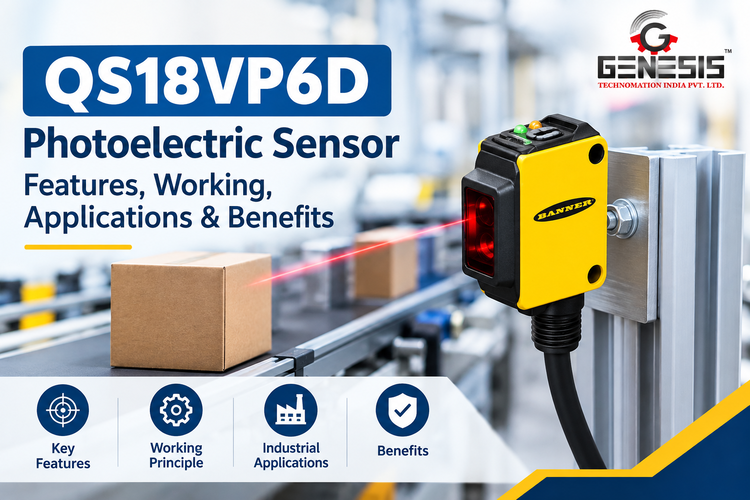
The QS18VP6D photoelectric sensor is one example of an industrial sensing solution designed to support modern automation requirements. Featuring diffuse sensing technology, infrared light detection, a compact design, and fast switching performance, it can be used in applications that require dependable object detection and integration with industrial control systems. Understanding its sensing technology, capabilities, applications, and installation requirements can help engineers make informed decisions when designing automated equipment.
Understanding Photoelectric Sensor Technology
Photoelectric sensors operate by transmitting light and monitoring how it interacts with objects in the sensing area. The technology is commonly used for presence detection, object positioning, product counting, and monitoring movement in automated machinery. Since the sensing process does not require physical contact, it can be used for products that need to move freely through a production line without being disturbed.
There are different types of photoelectric sensing methods, each designed for specific applications. Through-beam sensors use separate emitter and receiver units, while retro-reflective sensors detect light returned from a reflector. Diffuse sensors, on the other hand, detect light reflected directly from the target object.
Diffuse sensing is convenient for machine layouts where installing a separate receiver or reflector is difficult. It allows the sensor to operate from a single mounting position, making installation simpler in many general-purpose applications.
The QS18VP6D uses diffuse infrared sensing. Its infrared light is not normally visible to the human eye, but the sensor’s internal receiver can detect the reflected signal. This sensing method is useful for detecting objects in applications where a compact sensor and straightforward installation are preferred.
Key Technical Specifications and Features
Understanding the technical characteristics of the QS18VP6D helps engineers determine whether it meets the requirements of a particular automation project. The sensor combines an industrial housing, adjustable sensitivity, infrared sensing, and a solid-state switching output.
Its main specifications include:
| Specification | Details |
| Sensor family | WORLD-BEAM QS18 |
| Sensing method | Diffuse photoelectric |
| Light source | Infrared LED |
| Wavelength | 940 nm |
| Maximum detection range | 450 mm |
| Operating voltage | 10–30 V DC |
| Output type | PNP |
| Output configuration | Complementary solid-state |
| Response time | 0.6 ms |
| Repeatability | 150 µs |
| Power-up delay | 100 ms |
| Protection rating | IP67 |
| Operating temperature | -20°C to +70°C |
| Housing material | ABS |
| Lens material | Acrylic |
| Sensitivity adjustment | Potentiometer |
| Cable length | 2 metres |
| Connection | Four-wire cable |
These features make the sensor suitable for many general industrial applications. Nevertheless, selecting a sensor should always involve reviewing the actual machine requirements, target characteristics, wiring arrangement, and environmental conditions.
Exploring Detection Range and Sensing Accuracy
Detection range is one of the most important factors when evaluating a photoelectric sensor. The QS18VP6D offers a maximum sensing distance of 450 mm, allowing it to detect objects from a moderate distance without requiring physical contact.
This range can provide flexibility when designing machinery. For example, a sensor can be mounted beside a conveyor to detect cartons or containers as they move through a production area. It may also be used to monitor the presence of components at assembly stations or detect objects entering a machine.
However, the maximum sensing distance does not mean that every target will be detected at exactly the same distance. Diffuse sensors rely on the amount of reflected light received from an object, and different surfaces produce different optical responses.
Target Material and Reflectivity
Target reflectivity plays a significant role in detection performance. Light-coloured surfaces often reflect more infrared light, while darker materials may absorb a larger portion of the emitted light.
This difference can influence the effective detection distance. For example, a white cardboard box may be detected at a greater distance than a black plastic component under the same conditions.
Engineers should test the sensor with the actual products used in the application. Testing different colours, materials, sizes, and surface finishes helps establish a reliable operating distance.
Background Interference
Background objects can sometimes influence diffuse sensing. If a machine surface or another object behind the intended target reflects sufficient light, the sensor may detect the background when the target is absent.
To reduce this possibility, the sensor should be positioned carefully, and its sensitivity should be adjusted according to the target and background conditions. A suitable mounting angle may also help minimize unwanted reflection.
Repeatability and Consistent Detection
Repeatability describes the sensor’s ability to respond consistently under similar operating conditions. In automated production, consistent detection is important because machines often perform the same operation thousands of times.
Reliable repeatability helps support product counting, positioning, machine sequencing, and process monitoring. It reduces the likelihood of inconsistent detection signals that could interrupt production or require manual correction.
Response Time and High-Speed Automation
Modern production systems often operate at high speeds. Products may move rapidly along conveyors, pass through inspection stations, or enter automated packaging equipment within short intervals. In these applications, the sensor must respond quickly enough to identify objects and provide the required control signal.
The QS18VP6D has a response time of approximately 0.6 milliseconds. This fast switching performance makes it useful for applications involving moving products and repetitive detection events.
Supporting Accurate Product Counting
Product counting is a common use of photoelectric sensors. When an item passes through the sensing area, the sensor changes its output state. A PLC or counting system can then register the event.
For accurate counting, the sensor must detect every item while avoiding multiple signals from the same object. Product spacing, conveyor speed, target shape, and PLC input configuration should be considered when designing the counting system.
The sensor’s response time can help support fast detection, but the complete system must also be configured correctly.
Machine Sequencing and Timing
Sensors are often used to initiate specific machine operations. A detection signal may trigger a pneumatic cylinder, activate a conveyor section, start a labeling process, or allow another production step to begin.
Fast response can help improve the timing of these operations. However, engineers should consider the complete response of the system, including sensor switching, PLC scan time, input filtering, output processing, and mechanical movement.
When precise timing is required, testing the complete machine under real operating conditions is recommended.
Integration with PLCs and Industrial Control Systems
Photoelectric sensors are an important part of industrial control architecture. They provide information about the physical environment, allowing PLCs and other controllers to make decisions based on product position, presence, movement, or process status.
The QS18VP6D uses a PNP output configuration, which is commonly compatible with PLC input circuits designed to receive sourcing signals. When the output switches on, it provides a positive voltage signal to the connected input, provided the electrical configuration is compatible.
Electrical Compatibility
Before integrating the sensor into a control system, engineers should verify the supply voltage, output type, load requirements, wiring arrangement, and PLC input specifications.
The sensor operates from a 10–30 V DC supply, which supports use with many standard industrial power systems. A stable supply voltage and correct wiring help ensure consistent performance.
Incorrect wiring, loose terminals, electrical noise, or unsuitable PLC input settings may cause intermittent operation or prevent the sensor from working as expected.
Complementary Output Functionality
The complementary solid-state output arrangement provides switching functionality associated with light-operate and dark-operate conditions. This gives engineers flexibility when configuring detection logic for different applications.
The required output behavior should be confirmed during installation. The sensor should be tested to verify that the PLC receives the expected signal when the target is present and when it is absent.
Proper integration is particularly important in applications involving automated counting, product transfer, sorting, or machine interlocking.
Applications in Modern Automation
The versatility of photoelectric sensing technology allows the QS18VP6D to be used in a variety of industrial environments. Its suitability depends on the detection requirements, target material, mounting position, and operating conditions.
1. Conveyor and Material Handling Systems
Conveyor systems rely on sensors to monitor products moving between different machine stations. The QS18VP6D can detect packages, boxes, containers, and other objects as they pass through a sensing area.
Detection signals may be used for product counting, conveyor control, transfer coordination, and monitoring the presence of items at specific positions. This helps reduce manual monitoring and supports more consistent material flow.
2. Packaging Machinery
Packaging equipment requires accurate product detection during filling, sealing, labeling, wrapping, and carton handling operations. A photoelectric sensor can confirm that an item is present before a machine performs its next operation.
The sensor may also be used to detect gaps between products, monitor package movement, or provide a signal to a control system when a product reaches a particular position.
3. Assembly and Manufacturing Lines
Automated assembly processes often require confirmation that a component has been placed correctly or that a product is ready for the next manufacturing step.
Photoelectric sensors can help identify the presence of components on fixtures, detect products moving between stations, and support automated machine sequencing. These applications can improve process consistency and reduce the risk of incomplete operations.
4. Product Sorting and Distribution
Sorting systems use sensors to detect products before they are redirected into different pathways. The detection signal can be processed by a PLC that controls diverters, gates, or other mechanisms.
In these applications, sensor response and product spacing are important. The sensor should detect each product reliably, while the control system must process the signal quickly enough to activate the correct sorting mechanism.
5. Warehouse Automation
Warehouse equipment may use photoelectric sensors to monitor packages, containers, and materials moving through automated handling systems.
Detection can support package transfer, conveyor accumulation, automated loading processes, and movement monitoring. Sensors help machines respond to product presence without requiring manual observation.
Installation and Setup Best Practices
Correct installation is essential for achieving dependable sensing performance. Even a sensor with suitable specifications may produce inconsistent results if it is incorrectly positioned, poorly aligned, or improperly adjusted.
Select an Appropriate Mounting Location
Choose a mounting position that provides a clear view of the target. Avoid locations where machine structures, cables, moving components, or background objects may interfere with detection.
The sensor should be positioned so that the target enters the sensing area consistently during normal machine operation.
Adjust Sensitivity
The QS18VP6D includes a potentiometer for sensitivity adjustment. The adjustment should be configured according to the target material, sensing distance, and background conditions.
Avoid setting sensitivity unnecessarily high. Excessive sensitivity may cause detection of background objects, while insufficient sensitivity may result in missed targets.
Secure the Sensor
Use suitable mounting hardware to prevent vibration or unwanted movement. A sensor that shifts during operation may experience changes in its sensing position, leading to inconsistent detection.
Route the Cable Properly
The cable should be routed away from sharp edges, moving machinery, excessive heat, and areas where it may be damaged. Avoid unnecessary tension or bending that could affect the cable over time.
Test the Sensor During Operation
After installation, test the sensor with the machine running at its normal speed. Confirm that it detects the intended objects consistently and that the connected PLC receives the correct switching signals.
Testing should include different target positions and, where relevant, variations in product spacing and movement.
Environmental Protection and Reliability
Industrial environments can expose sensors to dust, moisture, vibration, temperature changes, and contamination. These factors can influence optical sensing performance and long-term reliability.
The QS18VP6D features an IP67 protection rating, which provides protection against dust ingress and temporary immersion under specified testing conditions. This makes it suitable for many industrial environments where dust or occasional moisture exposure may occur.
However, the model is not specifically identified as washdown-rated or chemically resistant. Applications involving aggressive cleaning procedures, chemicals, or continuous exposure to water should be evaluated carefully before installation.
Temperature Considerations
The sensor’s specified operating temperature range is -20°C to +70°C. Engineers should confirm that the temperature near the sensor remains within this range during normal operation.
Heat generated by motors, machine enclosures, heaters, and other equipment may affect the local operating environment. Proper positioning can help reduce unnecessary thermal exposure.
Preventive Maintenance
Although photoelectric sensors have no moving sensing parts, preventive maintenance can help maintain reliable operation.
Maintenance teams should periodically inspect the optical lens, mounting arrangement, cable, and electrical connections. Cleaning the sensing surface when necessary helps maintain the reflected light signal.
If the sensor begins producing inconsistent detection signals, checking the lens condition and mounting position should be among the first troubleshooting steps.
Common Troubleshooting Issues
Understanding common sensor problems can help maintenance teams reduce unnecessary downtime and identify faults more efficiently.
The sensor does not detect objects: Check the supply voltage, wiring, sensitivity setting, target distance, and target reflectivity. Ensure the object is within the effective detection range.
The sensor detects unwanted background objects: Review the sensor position and sensitivity adjustment. Background surfaces may reflect enough infrared light to trigger the output.
Detection is intermittent: Inspect the mounting arrangement, lens condition, cable connections, target movement, and possible electrical interference.
The output does not change: Verify the electrical connections, PLC input compatibility, supply voltage, and sensing configuration. Confirm that the target is entering the sensor’s detection area.
The sensor triggers multiple times: Check product spacing, object shape, vibration, PLC input filtering, and the sensor’s position relative to the moving target.
A systematic troubleshooting process can help identify the cause of detection problems without replacing components unnecessarily.
Advantages of Photoelectric Technology for Modern Automation
Photoelectric sensors offer several advantages compared with traditional contact-based sensing devices. Their non-contact operating principle reduces mechanical wear and makes them suitable for applications involving frequent movement and repetitive detection.
They can support fast production processes, detect objects without physically touching them, and provide signals for automated control systems. Their compact design also makes them convenient to integrate into machinery where mounting space is limited.
The QS18VP6D combines these advantages with diffuse infrared detection, a moderate sensing distance, adjustable sensitivity, PNP output, and industrial environmental protection. When correctly selected and installed, it can contribute to more reliable production monitoring and improved process efficiency.
Automation technology continues to evolve, but dependable object detection remains one of the foundations of industrial control. Sensors help machines understand what is happening in their operating environment, allowing them to perform tasks with greater consistency and reduced manual intervention.
Conclusion
Exploring QS18VP6D photoelectric sensor technology highlights the importance of reliable sensing in modern automation. As manufacturing, packaging, material handling, and assembly processes become increasingly automated, sensors play a critical role in improving efficiency, accuracy, and production consistency.
The QS18VP6D provides diffuse infrared detection, a maximum sensing range of 450 mm, a response time of 0.6 milliseconds, PNP output functionality, adjustable sensitivity, and IP67 protection. These characteristics make it a useful option for various industrial object-detection applications.
Its actual performance depends on target reflectivity, installation distance, environmental conditions, electrical compatibility, and proper sensitivity adjustment. Selecting the correct mounting position and maintaining the sensor’s optical surface can help reduce detection errors and unnecessary production interruptions.
For engineers, machine builders, and automation professionals, understanding how the sensor works and where it can be used is essential for designing efficient control systems. With appropriate selection, installation, and maintenance, the QS18VP6D can support dependable detection and help modern automated machines operate more smoothly and consistently.
The article is structured for SEO with the exact keyword QS18VP6D in the fifth paragraph, relevant subheadings, technical specifications, industrial applications, installation advice, and troubleshooting information.