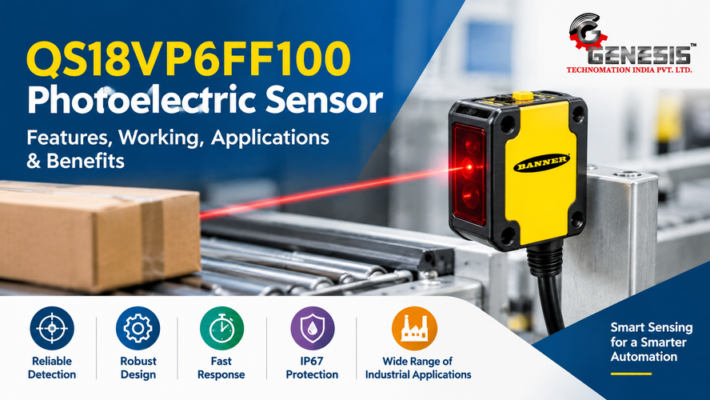
QS18VP6FF100 Photoelectric Sensor: Uses and Selection Guide
Industrial automation depends on accurate sensing technologies to monitor products, detect objects, and control machine operations. Photoelectric sensors play an important role in modern manufacturing because they provide non-contact detection and help automate repetitive production tasks. Industries use these sensors in packaging machines, conveyor systems, assembly lines, material handling equipment, and automated inspection systems. Their ability to detect objects without physical contact makes them suitable for applications that require consistent performance and reduced mechanical wear.
Selecting the right photoelectric sensor can improve production efficiency, reduce detection errors, and support reliable machine operation. However, every industrial application has different requirements. Factors such as sensing distance, target material, detection speed, output configuration, mounting arrangement, and environmental conditions influence sensor selection. Engineers must evaluate these factors before choosing a suitable sensing device for their automation systems.
Photoelectric sensors use light to identify the presence or absence of an object. Depending on their sensing technology, they can detect products through reflected light, interruption of a light beam, or changes in the distance between the sensor and the target. These detection methods help manufacturers automate different processes without depending on mechanical contact switches.
The Banner QS18 series offers photoelectric sensing solutions for different industrial detection requirements. These sensors come in different configurations to support applications involving object detection, product positioning, and machine control. Understanding the sensing principle and technical characteristics of a particular model helps engineers determine whether it matches their production requirements.
The QS18VP6FF100 Photoelectric Sensor is a fixed-field photoelectric sensing solution designed for short-range object detection. It offers a 100 mm sensing cutoff, visible red LED operation, complementary PNP output, and an industrial IP67 protection rating. These characteristics make it worth considering for applications that require reliable detection within a defined sensing area. This guide explains its uses, working principle, important features, selection considerations, and industrial applications.
What Is the QS18VP6FF100 Photoelectric Sensor?
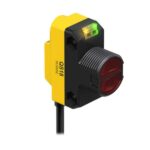
The QS18VP6FF100 is part of the Banner Engineering WORLD-BEAM QS18 photoelectric sensor family. It uses fixed-field sensing technology to identify objects within a defined detection range.
Unlike mechanical detection devices, this sensor does not require direct physical contact with the target. It uses an optical system to detect changes in reflected light and generates an electrical output signal when an object enters the sensing field.
The fixed-field sensing principle helps distinguish the intended target from background objects located beyond the sensor’s cutoff distance. This characteristic is useful in industrial environments where background surfaces can otherwise affect detection reliability.
The QS18VP6FF100 has a compact industrial housing and an M18 mounting arrangement. Engineers can consider it for machine installations where space availability and accurate short-range detection are important.
Before selecting this model, users should verify the complete technical specifications and wiring information against the manufacturer’s latest datasheet.
Working Principle of QS18VP6FF100 Photoelectric Sensor
Understanding the working principle helps engineers use the sensor correctly and achieve consistent detection performance.
The QS18VP6FF100 operates using visible red LED light and fixed-field background suppression technology. Its optical system evaluates reflected light from objects within the defined sensing field.
The working process involves several stages.
1. Light Transmission
The sensor generates visible red LED light through its optical transmitter. This light travels toward the detection area and interacts with objects present within the sensing field.
The visible light also helps technicians identify the approximate sensing direction during installation and alignment.
2. Object Reflection
When an object enters the sensing area, its surface reflects a portion of the transmitted light toward the sensor’s receiving system.
The amount and characteristics of reflected light depend on factors such as target distance, surface finish, material, shape, and colour.
3. Optical Signal Evaluation
The sensor’s internal optical arrangement evaluates the received light to determine whether the object falls within its fixed sensing field.
Fixed-field technology helps reduce the influence of background objects beyond the defined cutoff point.
4. Electrical Signal Generation
When the sensor detects a suitable target, its internal electronics change the output state.
The QS18VP6FF100 uses a complementary solid-state PNP output. This signal can communicate the detection status to compatible PLCs and industrial controllers.
5. Automated Machine Response
The connected control system processes the sensor signal and performs the programmed operation.
For example, a PLC can use the detection signal to count products, control conveyor movement, activate an actuator, or initiate a packaging sequence.
This entire process allows the sensor to support automated object detection without requiring physical contact.
Key Technical Features of QS18VP6FF100
The technical characteristics of a photoelectric sensor determine its suitability for different industrial applications.
The important specifications of the QS18VP6FF100 include:
- Manufacturer: Banner Engineering
- Product Family: WORLD-BEAM QS18
- Sensing Technology: Fixed-field photoelectric sensing
- Sensing Cutoff: 100 mm
- Light Source: Visible red LED
- Wavelength: 630 nm
- Supply Voltage: 10–30 V DC
- Output Configuration: Complementary solid-state PNP
- Response Time: 0.85 ms
- Protection Rating: IP67
- Operating Temperature: -20°C to +70°C
- Connection: 2 m cable
- Housing: Rectangular design with M18 mounting arrangement
These features provide a starting point for evaluating the sensor. However, actual performance depends on installation conditions, target characteristics, machine speed, and compatibility with the control system.
Industrial Uses of QS18VP6FF100 Photoelectric Sensor
The QS18VP6FF100 can support different industrial detection tasks when its fixed-field sensing characteristics match the application requirements.
1. Conveyor Belt Object Detection
Conveyor systems transport products between different manufacturing and packaging stations. Accurate object detection helps controllers coordinate product movement and prevent unnecessary machine operations.
The QS18VP6FF100 can detect suitable objects passing through a defined detection point.
Manufacturers can use the sensor for:
- Product presence detection.
- Conveyor indexing.
- Package counting.
- Object transfer monitoring.
- Position confirmation.
For example, a manufacturing facility can install the sensor near a conveyor transfer point. When a product enters the sensing field, the sensor sends a signal to the PLC. The controller can then activate the next conveyor section or initiate another programmed operation.
2. Packaging Machinery
Packaging operations require accurate product detection at different stages of production. Machines need to identify containers, cartons, packages, and other products before performing filling, sealing, labeling, or sorting operations.
The QS18VP6FF100 can support suitable short-range detection tasks within packaging machinery.
Its non-contact sensing principle helps identify moving products without interfering with their physical movement.
Potential applications include:
- Package presence detection.
- Product positioning.
- Carton detection.
- Packaging sequence control.
- Product transfer monitoring.
Correct sensor positioning helps maintain reliable detection during continuous production.
3. Automated Assembly Lines
Assembly lines use sensors to monitor components and coordinate different production activities.
A photoelectric sensor can identify whether a component has reached a specific workstation. The control system can use this information to activate the next assembly process.
The QS18VP6FF100 can be considered for applications involving:
- Component presence detection.
- Workpiece positioning.
- Part transfer monitoring.
- Assembly sequence control.
- Automated machine triggering.
For example, an automated assembly machine can use the sensor to confirm the presence of a suitable component before starting an assembly operation.
4. Product Counting Systems
Product counting is an important requirement in manufacturing, packaging, and material handling.
Photoelectric sensors detect individual products as they pass through a defined sensing point. The PLC receives the output signals and increases the product count according to the programmed logic.
The QS18VP6FF100 can support counting applications when the target spacing, product dimensions, and operating speed suit its response characteristics.
Proper installation helps reduce missed detections and unwanted switching.
5. Material Handling Equipment
Material handling systems move products, components, and packages between different production areas.
Photoelectric sensors help monitor material movement and provide detection signals to automated equipment.
The QS18VP6FF100 can be evaluated for applications such as:
- Package transfer detection.
- Component presence monitoring.
- Conveyor movement coordination.
- Automated sorting triggers.
- Position monitoring.
Its compact mounting arrangement can help integrate the sensor into suitable machine structures.
6. Automated Inspection Machines
Industrial inspection systems often require sensors to identify the presence of products before performing quality checks.
A photoelectric sensor can provide a trigger signal when an object enters the inspection area.
The QS18VP6FF100 can support suitable product detection tasks in automated inspection setups. The controller can use its output signal to activate cameras, measurement devices, or other inspection equipment.
Its suitability depends on the required detection distance, target characteristics, and inspection speed.
7. Manufacturing and Production Machines
Manufacturing equipment uses photoelectric sensors to monitor different stages of production.
The QS18VP6FF100 can be considered for applications involving workpiece detection, machine cycle monitoring, product positioning, and automated material transfer.
Engineers should evaluate the target and background conditions before finalizing the installation.
Key Benefits of QS18VP6FF100 Photoelectric Sensor
Choosing a suitable sensor can improve machine performance and support efficient industrial operations.
1. Non-Contact Detection
The sensor detects objects through light rather than physical contact.
This approach reduces mechanical wear associated with contact-based switches. It also makes photoelectric sensing useful for moving products and applications involving delicate objects.
2. Fixed-Field Background Suppression
The fixed-field sensing technology helps distinguish objects within the defined detection range from background surfaces beyond the cutoff.
This feature can improve detection reliability in applications where background interference creates challenges.
3. Fast Response Time
The specified response time of 0.85 ms supports applications that require quick object detection.
Fast signal generation can help industrial controllers coordinate machine operations during continuous production.
However, overall response also depends on PLC processing time and machine-control logic.
4. Industrial Protection
The IP67-rated housing provides protection against dust ingress and temporary immersion under specified test conditions.
This feature makes the sensor suitable for many industrial installations where dust and moisture may be present.
5. Compact Mounting Design
The sensor’s rectangular housing and M18 mounting arrangement support integration into suitable machine layouts.
This can help machine builders install the sensor in areas with limited mounting space.
6. PNP Output Compatibility
The complementary solid-state PNP output supports integration with compatible industrial controllers and PLC input systems.
Engineers should confirm the electrical specifications and wiring arrangement before connecting the sensor.
Complete Selection Guide for QS18VP6FF100
Selecting the right photoelectric sensor requires more than checking its sensing distance. Engineers must evaluate the complete application to determine whether the model meets the required detection conditions.
The following factors can help simplify the selection process.
1. Identify the Required Sensing Distance
Sensing distance is one of the most important factors when choosing a photoelectric sensor.
The QS18VP6FF100 has a 100 mm fixed-field cutoff. Therefore, it is suitable for applications where the intended detection point falls within its specified sensing range.
Before installation, measure the distance between the sensor and the target.
Avoid selecting this model if your application requires detection beyond its specified operating range.
2. Understand the Target Material
Different materials reflect light differently.
For example, metal, plastic, cardboard, glass, and other surfaces may produce different optical responses.
Consider the following target characteristics:
- Surface reflectivity.
- Object colour.
- Target dimensions.
- Surface texture.
- Object shape.
- Distance from the sensor.
Test the sensor with the actual production material whenever possible.
3. Evaluate Background Conditions
Fixed-field background suppression helps reduce the influence of objects beyond the cutoff point.
However, engineers should still evaluate the background surface, its distance, and its reflectivity.
If the target and background are close together, perform practical detection tests before finalizing the sensor position.
4. Check the Output Configuration
The QS18VP6FF100 features a complementary solid-state PNP output.
Before purchasing, verify whether your PLC or controller supports PNP sourcing inputs.
Also check the wiring diagram, load requirements, and required switching logic.
Correct electrical compatibility helps prevent connection problems and unwanted machine behavior.
5. Verify the Operating Voltage
The sensor requires a 10–30 V DC supply.
Check the available power supply in your automation system and confirm that it remains within the specified operating range.
Stable power helps maintain consistent sensor operation.
6. Consider Environmental Conditions
Industrial environments may expose sensors to dust, moisture, temperature changes, and vibration.
The QS18VP6FF100 has an IP67 protection rating and an operating temperature range of -20°C to +70°C.
Compare these ratings with your actual installation conditions.
For applications involving aggressive chemicals, high-pressure washdown, or extreme environmental exposure, verify compatibility with the manufacturer.
7. Check Response Time
Response time determines how quickly a sensor changes its output after detecting an object.
The QS18VP6FF100 has a specified response time of 0.85 ms.
For high-speed production applications, compare this specification with product speed, object spacing, and PLC scan time.
This helps determine whether the sensor can reliably detect individual objects without missing signals.
8. Evaluate Mounting and Connection Requirements
The QS18VP6FF100 features an M18 mounting arrangement and a 2 m cable.
Before ordering, check:
- Available mounting space.
- Mounting bracket compatibility.
- Cable routing distance.
- Protection from mechanical damage.
- Accessibility for maintenance.
Proper mounting and cable management help maintain reliable operation.
Common Mistakes to Avoid When Selecting a Photoelectric Sensor
Even a technically advanced sensor may not perform as expected if engineers overlook important application requirements.
Avoid these common mistakes:
Selecting an unsuitable sensing range: Always compare the required detection distance with the sensor’s specified cutoff.
Ignoring target characteristics: Reflective, dark, transparent, or irregularly shaped objects may require additional application testing.
Choosing the wrong output type: Confirm whether your control system requires PNP or NPN output.
Overlooking background conditions: Background surfaces can influence optical detection. Evaluate the target and background arrangement.
Ignoring environmental protection: Match the sensor’s IP rating and temperature limits with the operating environment.
Incorrect mounting: Poor alignment or unstable mounting can affect detection consistency.
Skipping practical testing: Always test the sensor under actual production conditions before completing the machine installation.
Installation and Maintenance Tips
Correct installation and regular maintenance help maintain consistent detection performance.
Follow these recommendations when using the QS18VP6FF100:
- Install the sensor at the appropriate distance from the target.
- Secure the mounting arrangement to prevent vibration.
- Ensure that the target enters the defined sensing field.
- Follow the manufacturer’s wiring diagram.
- Confirm PNP output compatibility with the controller.
- Keep the optical surface clean.
- Inspect cables and connectors periodically.
- Test detection performance during normal production operations.
Regular inspection can help identify contamination, loose connections, and mounting problems before they affect production.
Best Place to Buy QS18VP6FF100 Photoelectric Sensor in India
Finding a reliable industrial automation supplier is important when purchasing sensors for manufacturing equipment, packaging machinery, and other automated systems.
Genesis Technomation India Pvt. Ltd. offers industrial automation products and sensing solutions for different industrial requirements.
If you are searching for the QS18VP6FF100 Photoelectric Sensor in India, Genesis Technomation is a suitable supplier to contact for product information, availability, and purchasing assistance.
Reasons to consider Genesis Technomation include:
- Industrial automation product solutions.
- Photoelectric and proximity sensing products.
- Solutions for different manufacturing applications.
- Assistance with product selection and purchasing enquiries.
- Automation products for machine builders and industrial users.
Best place to Buy QS18VP6FF100 Photoelectric Sensor:
Contact Genesis Technomation to confirm product availability, current pricing, and technical details before placing your order.
Frequently Asked Questions (FAQs)
1. What is the QS18VP6FF100 Photoelectric Sensor?
The QS18VP6FF100 is a Banner Engineering fixed-field photoelectric sensor designed for non-contact object detection in industrial automation applications.
2. What is the sensing distance of QS18VP6FF100?
The sensor has a specified fixed-field cutoff of 100 mm. It is suitable for applications that require detection within this defined range.
3. What type of output does QS18VP6FF100 provide?
It uses a complementary solid-state PNP output for integration with compatible industrial control systems.
4. What is the operating voltage of QS18VP6FF100?
The sensor operates with a 10–30 V DC power supply.
5. Where can QS18VP6FF100 be used?
It can be considered for conveyor systems, packaging machinery, automated assembly lines, product counting, material handling, and manufacturing equipment.
6. What is the protection rating of QS18VP6FF100?
The sensor has an IP67 protection rating, which provides dust protection and protection against temporary immersion under specified test conditions.
7. How do I select the right photoelectric sensor?
Consider sensing distance, target material, background conditions, output configuration, supply voltage, response time, environmental protection, and mounting requirements.
8. Where can I Buy QS18VP6FF100 Photoelectric Sensor in India?
You can contact Genesis Technomation India Pvt. Ltd. for product information and purchasing assistance.
Visit: https://genesisindsol.in/qs18vp6ff100-photoelectric-sensor/
Conclusion
The QS18VP6FF100 Photoelectric Sensor is a useful option for industrial applications that require short-range, non-contact object detection. Its fixed-field background suppression, 100 mm cutoff, visible red LED, complementary PNP output, fast response time, and IP67 protection rating make it suitable for evaluating different automation requirements.
From conveyor belt systems and packaging machinery to automated assembly lines and product counting applications, this sensor can support reliable object detection when engineers select and install it correctly.
However, choosing the right photoelectric sensor requires careful evaluation of the target material, sensing distance, background conditions, electrical compatibility, and environmental requirements.
For businesses looking to purchase the QS18VP6FF100 Photoelectric Sensor in India, Genesis Technomation India Pvt. Ltd. is a supplier worth contacting for product details and purchasing assistance. Selecting the right sensor and matching it with the application can help improve automation efficiency, support consistent machine operation, and reduce unnecessary production interruptions.