
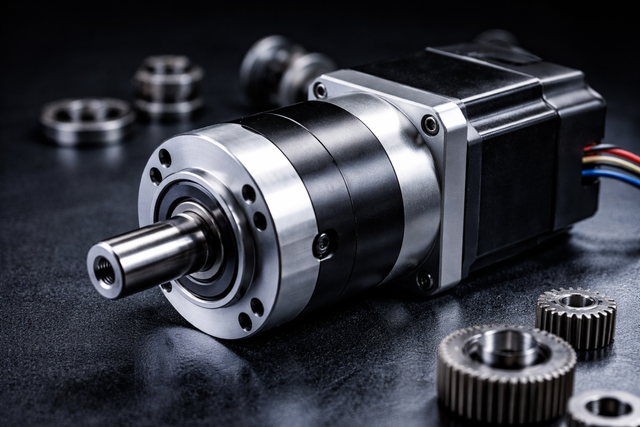
How a Stepper Motor Planetary Gearbox Improves Precision & Torque
Modern automation systems rely heavily on motion control technologies that deliver both accuracy and reliability. Among the most widely used components in these systems is the stepper motor. Known for its ability to move in precise increments, the stepper motor is commonly used in applications such as CNC machines, 3D printers, robotics, packaging equipment, and medical devices. However, while stepper motors offer excellent positional control, their torque output and precision can sometimes be limited when used alone. This is where a planetary gearbox becomes a powerful companion.
A planetary gearbox, also called a planetary gear system, is a compact gear arrangement designed to increase torque while maintaining high efficiency and stability. When integrated with a stepper motor, it forms a powerful motion control solution capable of delivering higher torque, smoother operation, and improved positioning accuracy. The combination enhances the motor’s performance in demanding industrial and automation environments where both precision and power are required.
To understand why this combination is so effective, it is important to first understand how stepper motors function. A stepper motor operates by dividing a full rotation into a number of equal steps. Each electrical pulse sent to the motor moves the shaft by a fixed step angle. Because of this, stepper motors can achieve precise positioning without the need for complex feedback systems. However, when the load increases or when the system requires higher torque at lower speeds, the motor alone may struggle to deliver consistent performance.
This is where the planetary gearbox plays a critical role. A planetary gearbox consists of three main components: a central sun gear, several planet gears that rotate around the sun gear, and an outer ring gear that holds the system together. The planet gears are mounted on a carrier that transmits the output. This configuration allows the gearbox to distribute the load evenly across multiple gears, resulting in higher torque capacity and smoother motion compared to traditional gear systems.
When integrated with a stepper motor, the system is often referred to as a Stepper Motor Planetary Reducer. This combination significantly enhances the motor’s torque output while reducing speed in a controlled and efficient manner. By lowering the rotational speed and multiplying torque, the reducer allows the motor to handle heavier loads and more demanding applications without sacrificing accuracy or stability.
Table of Contents
- 1 Understanding the Working Principle of Planetary Gearboxes
- 2 How Gear Reduction Improves Precision
- 3 Increasing Torque Without Increasing Motor Size
- 4 Improved Stability and Smooth Motion
- 5 Enhanced Load Handling Capability
- 6 Compact Design with High Efficiency
- 7 Reduced Backlash for Better Position Control
- 8 Applications Across Multiple Industries
- 9 Long Service Life and Reliability
- 10 Choosing the Right Gear Ratio
- 11 Future Trends in Motion Control Technology
- 12 Conclusion
Understanding the Working Principle of Planetary Gearboxes
The working principle of a planetary gearbox is based on load distribution and gear reduction. Unlike conventional gear systems where only a few teeth carry the load, planetary gearboxes distribute the load across multiple gear teeth simultaneously. This unique design increases the gearbox’s durability, efficiency, and torque capacity.
When the stepper motor rotates the sun gear, the surrounding planet gears begin to rotate around it. These planet gears are held by the planet carrier and mesh with the outer ring gear. Because several gears share the load, the system can transmit more torque while maintaining compact dimensions.
Another advantage of the planetary gear design is its coaxial structure. Both the input and output shafts lie on the same axis. This makes the gearbox highly compact and suitable for applications where space is limited. Despite its small size, it can provide significant torque multiplication, which is essential in industrial automation systems.
How Gear Reduction Improves Precision
Precision is one of the most important aspects of motion control systems. Even a slight positioning error can lead to product defects, system inefficiencies, or mechanical wear. A planetary gearbox improves precision by reducing the motor’s step size at the output shaft.
For example, if a stepper motor has a step angle of 1.8 degrees per step, adding a gearbox with a 10:1 reduction ratio effectively reduces the output step angle to 0.18 degrees. This means the system can achieve much finer positioning control. Smaller movement increments translate into smoother and more accurate motion.
This improvement in resolution is especially valuable in applications like CNC machining, laser cutting, and semiconductor manufacturing where extremely precise positioning is required. The gearbox allows the motor to make smaller, controlled movements without requiring more complex motor designs.
Increasing Torque Without Increasing Motor Size
One of the biggest advantages of using a planetary gearbox with a stepper motor is the ability to increase torque without increasing motor size. Torque multiplication occurs through the gear reduction ratio. For instance, if a gearbox has a 20:1 reduction ratio, the output torque can theoretically increase by up to twenty times, minus efficiency losses.
This allows engineers to use smaller motors while still achieving the required torque for heavy loads. As a result, systems become more compact, energy efficient, and cost effective. Smaller motors also produce less heat and consume less power, which improves overall system efficiency.
In many industrial applications, machines must operate continuously for long periods. By using a planetary gearbox, the motor operates under less stress because the gearbox shares the load. This improves the lifespan of both the motor and the mechanical components.
Improved Stability and Smooth Motion
Stepper motors are known for their precise control, but they can sometimes produce vibrations or resonance when operating at certain speeds. These vibrations can affect system accuracy and cause noise or mechanical wear.
A planetary gearbox helps minimize these issues. Because multiple gears share the load and the gear engagement is more balanced, the motion becomes smoother and more stable. The gearbox also increases rotational inertia, which helps dampen vibrations and reduces sudden speed fluctuations.
This smoother motion is particularly important in applications such as camera positioning systems, medical imaging devices, and precision assembly equipment. In these systems, even small vibrations can impact performance or product quality.
Enhanced Load Handling Capability
Industrial machines often need to move heavy loads while maintaining precise positioning. A stepper motor alone may struggle to deliver sufficient torque when handling heavy components. By adding a planetary gearbox, the system gains the ability to manage higher loads without losing precision.
The load-sharing mechanism within the gearbox distributes stress evenly across multiple gears. This prevents excessive wear on individual gear teeth and increases the system’s durability. As a result, planetary gearboxes are capable of handling higher loads than traditional gear mechanisms.
This makes them ideal for applications such as automated guided vehicles (AGVs), robotic arms, packaging machines, and conveyor systems. In these environments, equipment must operate reliably while moving significant loads.
Compact Design with High Efficiency
Another key benefit of planetary gearboxes is their compact and lightweight design. Traditional gear systems capable of delivering similar torque levels are often much larger and heavier. Planetary gearboxes achieve high torque density because of their unique internal structure.
Despite their compact size, planetary gearboxes maintain high efficiency, often exceeding 90%. This means most of the motor’s energy is transmitted to the output shaft rather than being lost as heat. High efficiency is essential in modern automation systems where energy consumption and thermal management are critical factors.
The compact design also makes planetary gearboxes easy to integrate into existing systems. Engineers can add them to machines without making major structural modifications.
Reduced Backlash for Better Position Control
Backlash refers to the small amount of play or movement between gear teeth when the direction of motion changes. Excessive backlash can reduce positioning accuracy and cause delays in motion control systems.
High-quality planetary gearboxes are designed with low backlash characteristics. Precision machining and tight tolerances ensure that the gears mesh smoothly with minimal clearance. This results in more accurate and responsive motion control.
In robotics and automated manufacturing, low backlash is extremely important. Robotic arms, for example, must move precisely to perform tasks such as welding, assembly, or pick-and-place operations. A planetary gearbox helps maintain this level of accuracy.
Applications Across Multiple Industries
The combination of stepper motors and planetary gearboxes is widely used across many industries. In manufacturing, they power CNC machines, automated assembly lines, and material handling systems. In robotics, they provide the precise movement needed for articulated arms and mobile robots.
The medical industry also benefits from this technology. Equipment such as surgical robots, laboratory automation systems, and diagnostic devices rely on precise motion control. Planetary gearboxes help ensure that these machines operate smoothly and accurately.
Other industries using this technology include aerospace, packaging, printing, textile manufacturing, and semiconductor production. As automation continues to advance, the demand for high-precision motion control systems will only grow.
Long Service Life and Reliability
Durability is another important factor in industrial equipment. Machines that operate continuously must be able to withstand long periods of use without frequent maintenance. Planetary gearboxes are designed for long service life due to their balanced load distribution and robust construction.
Because multiple gears share the load, individual components experience less stress. This reduces wear and extends the lifespan of the gearbox. Many planetary gearboxes are also manufactured using hardened steel gears and precision bearings to enhance durability.
Regular lubrication and proper installation further increase reliability. When maintained correctly, a stepper motor planetary gearbox system can operate efficiently for many years.
Choosing the Right Gear Ratio
Selecting the appropriate gear ratio is crucial for achieving optimal performance. The gear ratio determines how much the motor speed will be reduced and how much torque will be increased. Common ratios range from 3:1 to over 100:1 depending on the application.
Lower ratios provide moderate torque increase while maintaining higher speeds. Higher ratios deliver greater torque but reduce speed significantly. Engineers must carefully balance these factors based on the machine’s requirements.
Other factors to consider include backlash tolerance, load capacity, efficiency, and mounting compatibility with the stepper motor. Choosing the right combination ensures that the system performs efficiently and reliably.
Future Trends in Motion Control Technology
As industries move toward smarter automation and robotics, the demand for high-performance motion control systems continues to grow. Manufacturers are developing advanced planetary gearboxes with improved materials, better lubrication systems, and higher torque densities.
Integration with smart sensors and digital control systems is also becoming more common. These technologies allow real-time monitoring of performance, predictive maintenance, and improved energy efficiency.
In the future, stepper motor planetary gearbox systems will likely become even more compact, efficient, and intelligent. This will open new possibilities for automation across industries ranging from manufacturing and logistics to healthcare and consumer electronics.
Conclusion
The integration of a planetary gearbox with a stepper motor creates a powerful motion control solution capable of delivering higher torque, improved precision, and smoother operation. By distributing loads across multiple gears, the planetary gearbox enhances efficiency and durability while maintaining a compact design.
From robotics and CNC machines to medical devices and packaging equipment, this combination plays a vital role in modern automation systems. By increasing torque, reducing backlash, and improving positional accuracy, planetary gearboxes enable stepper motors to perform more effectively in demanding applications.
As technology continues to evolve, the role of stepper motor planetary gearbox systems will only become more significant. Their ability to deliver precision, power, and reliability makes them an essential component in the future of industrial automation and motion control.